Developing a Theory of Change to improve outcomes for care-experienced and estranged students

Representatives from Go Higher West Yorkshire’s (GHWY) Care-experienced and Estranged Students’ Network met at the University of Bradford on Monday, 3 November to develop a Theory of Change for our work. With November being both National Care Leavers Month and containing Estranged Students’ Solidarity Week, it felt like a good time to take a focus on these groups of learners.
Background to Theory of Change workshop
Our Care-experienced and Estranged Students’ Network, which was launched in 2022, brings together staff who work with these students from across our 13 partners. It offers a forum to share good practice, discuss shared challenges, and work towards collaborative outputs that support students to access and succeed in Higher Education (HE).
Last year, the Network collected a great staff case study that evidenced the value of our work. Members knew implicitly that there are benefits for participants but wanted to take a step back from what is being delivered day-to-day, and use a framework to more formally draw things out. A Theory of Change model was chosen because it maps out how and why an intervention strategy will lead to specific outcomes.
Workshop
The Network usually meets online to enable attendance from busy colleagues at geographically dispersed institutions. However, the Theory of Change workshop was in person to better ensure people could engage and learn from each other. It was both energising to be in a physical room together, and also mentally quite tiring towards the end with all the thinking we were doing!
We started by outlining the contexts as we saw them: those relevant to our network and its membership, and to the groups of learners we are seeking to better support. This meant we outlined who we are, what we do and why, including what the context is behind why care-experienced and estranged students have been chosen as a focus. We then thought through what we are trying to ultimately achieve with our combined efforts, and then worked our way towards that by thinking about the inputs we have, the activities we are – or could be – delivering, and the shorter-term outputs which will help us understand when we are moving towards our goals. Everything was collected in an online Padlet: you can see a screenshot of what we came up with below.
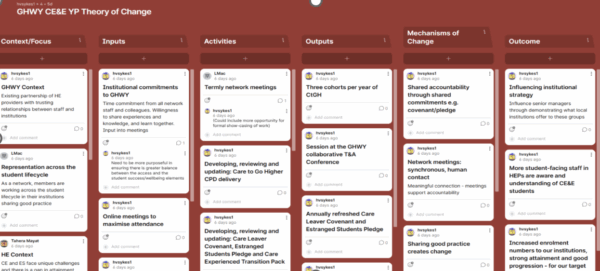
The workshop felt like a great exercise in collaborative thinking. Participants from a range of different HE provider contexts all brought the perspective from their institution, which helped us challenge our own assumptions.
Next steps
We took away some actions from the workshop to keep momentum going: all Network members have been asked to review what we added to our shared Theory of Change, GHWY staff will pull things together into a more concise and coherent Theory of Change document. Member institution reps are also investigating whether there is anonymised data that the group can usefully share and collate to understand any impact on the numbers of care-experienced and estranged students who identify themselves to their HE provider.
Helen Sykes, Head of GHWY and Co-chair of Care-experienced & Estranged Students’ Network