Driving climate action at Calderdale College: A regional response
Carly Breame, the newly appointed Sustainability Lecturer within the University Centre at Calderdale College, discusses the provider’s Climate Action Plan. The new role was created specifically to drive the Plan into reality, deliver dedicated sustainability courses, and build stronger partnerships with local organisations to support a greener future.
The regional challenge: West Yorkshire’s climate blueprint
To understand why we are taking such decisive action at Calderdale College, we only have to look at the regional picture. The West Yorkshire Combined Authority (WYCA) has set an ambitious target to tackle the climate emergency and make our region net zero carbon by 2038.
The scale of the challenge is significant. Currently, 45% of West Yorkshire’s emissions come from buildings, while 37% come from transport. Climate change is already affecting our communities, with 39,000 residential properties and 13,000 commercial properties at risk of flooding. In response, WYCA’s climate blueprint focuses on securing clean energy, expanding zero-emission transport, creating warm low-carbon homes, and developing green skills across the region.
West Yorkshire has already achieved a reduction of more than 40% in emissions since the 2005 baseline. However, to meet the ambitious 2038 net zero target, this must increase to an 81% reduction
Calderdale College’s response
At Calderdale College, we recognise that anchor institutions must lead by example. Sustainability is embedded within our corporate strategy through the ‘Planet’ section, creating a golden thread that runs through all college activities and priorities. This includes practical steps to decarbonise our estate, improve biodiversity, and ensure our students are equipped with the green skills needed for the future economy.
To turn these ambitions into action, I have been focused on getting key projects underway. Recent priorities include:
- Gathering data: Establishing a reporting system to gather data across the College, from energy, water and waste, so we can effectively measure our impact and track our progress toward our emission reduction targets.
- Driving waste management: Setting up comprehensive waste strategies, including pushing our food waste composting and driving clearer recycling practices across the campus.
- Enhancing communication: Preparing a dedicated sustainability page for our upcoming website to celebrate our achievements and share our progress with the wider community.
- Improving digital sustainability: Exploring how we can reduce our digital carbon footprint through smarter data management and default eco-friendly search engines.
- Engaging staff and students: Developing hands-on projects, including arts and environmental initiatives focused on climate action, alongside a new student sustainability committee launching next academic year.
- Building partnerships: Working with local networks and collaborating with Todmorden College to strengthen climate education and build wider regional partnerships.
I am incredibly excited to support this transition and work alongside our brilliant staff, students, and community partners to make West Yorkshire a greener, more sustainable place to live and learn.
Early progress and next steps
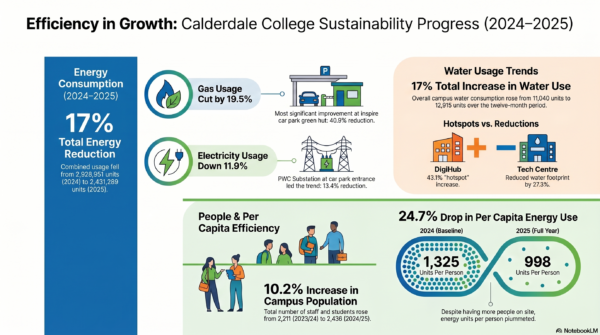
So far, this work has already highlighted some encouraging progress. Since establishing our 2024 baseline, we have seen a 17% reduction in energy usage across the main campus. This has largely been driven by more efficient use of campus spaces and improvements through ongoing building works. Specifically, we have seen a 40% reduction in gas usage at the Inspire building following installation of solar and LED.
In addition, staff and student numbers across the college increased by roughly 10% between 2023-24 and 2024-25, while still maintaining an overall reduction in energy usage. This represents an almost 25% reduction in energy usage per capita across the college.
Our data collection has also helped identify areas requiring further attention, particularly around water usage. We are continuing to develop systems for collecting waste and biodiversity data, and we plan to engage local specialists to support staff and students in gathering biodiversity information across the campus.
The image below shows the progress and data collected so far.
Carly Breame, Sustainability Lecturer, University Centre at Calderdale College